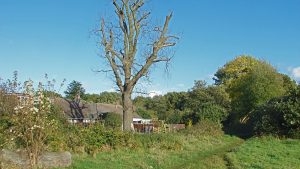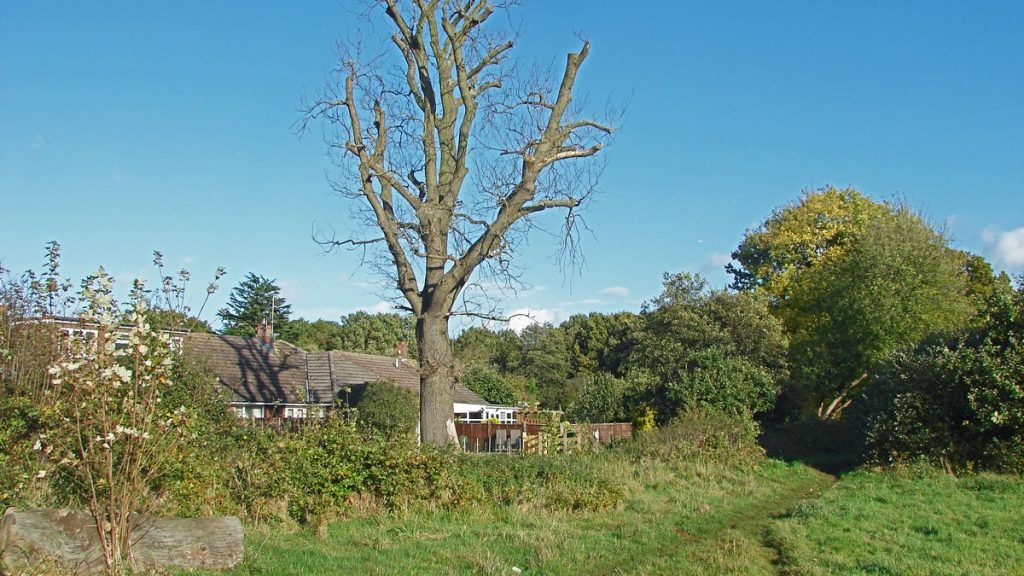
A tree is too big for its space, or its limbs hang over the roof, and the owner wants it smaller. That is a legitimate goal. But the method matters. Arborists widely reject one approach, topping, and ANSI A300 treats it as unacceptable. In contrast, another, crown reduction, can reduce size while protecting the tree’s health and structure. Here is the difference, explained by the ISA Certified Arborists at Bob Ray Company.
What Is Topping?
Topping is the indiscriminate cutting of tree branches to stubs or to lateral branches too small to take over as a leader. It often goes by other names: “heading,” “rounding over,” “hat-racking,” or “tipping.” The result is a tree with blunt stubs and a sudden loss of much of its leaf area.
Topping is fast and requires little skill, which is why some companies still offer it. But it causes serious harm:
- Starvation: removing large amounts of foliage cuts off the tree’s energy supply.
- Decay: large stub cuts on older wood are difficult for the tree to compartmentalize, allowing decay to spread.
- Weak regrowth: the tree responds with dense, fast-growing sprouts that attach weakly near the cut surface and are prone to breaking.
- Rapid return to height: those sprouts can quickly regrow, often making the tree taller and denser than before.
- Higher long-term cost: topped trees need frequent follow-up work and may eventually need removal.
What Is Crown Reduction?
Crown reduction, one of the pruning types defined in A300 Part 1, decreases the height or spread of a tree using reduction cuts. A reduction cut shortens a stem back to a lateral branch that is large enough to take over the terminal role. The tree keeps a natural form, a leaf-bearing branch at the end of each cut stem, and better ability to seal wounds.
A widely used ISA guideline is that the remaining lateral should be at least about one-third the diameter of the stem being removed. Smaller laterals may not be able to take over, which starts to look and act more like topping.
Crown Reduction Cuts vs. Heading Cuts
The difference comes down to where cuts end:
- Reduction cut: back to a suitable lateral branch that can assume dominance. This is the cut used in crown reduction.
- Heading cut: back to a bud, a stub, or a lateral too small to take over. A300 limits heading cuts to specific situations, such as young trees, shrubs, or specialized pruning systems maintained from an early age.
For details on how arborists place cuts, see our post on pruning large branches.
Pro tip: Ask your arborist where each reduction cut will end and what size lateral will remain. If the answer is “we’ll take it down about 10 feet,” without mentioning laterals, you may be looking at topping.
When Crown Reduction Makes Sense
Reduction is an appropriate objective in situations such as:
- Reducing end weight on long, heavy limbs extending over a structure
- Reducing the size of a limb with a defect, such as a crack or a weak union, to lower its likelihood of failure
- Providing clearance from buildings and roofs
- Managing a tree that has outgrown its space while keeping it healthy
Reduction still removes live tissue, so arborists must plan it carefully. Not every species responds well, and mature or stressed trees may tolerate only modest reduction. Sometimes arborists combine reduction with cabling and bracing to support a weak structure. Our post on why tree limbs fail explains the defects we look for.
Restoring a Topped Tree Without Further Crown Reduction
If your tree has already been topped, all is not lost. Restoration pruning is another A300 pruning type. Over several years, an arborist selects the strongest, best-placed sprouts to become new leaders and branches, removes or reduces competing sprouts, and gradually rebuilds a stronger structure. It takes patience, but it can greatly improve a tree’s safety and appearance. Arborists also use the same type of work after storm damage; see our post on storm-damaged trees.
When Removal Is the Better Answer
Sometimes a tree is simply the wrong size for its location, or it has defects that pruning cannot fix. In those cases, an honest arborist will tell you that removal may be the better long-term option instead of repeatedly cutting it back. We will walk you through the options and the trade-offs.
Frequently Asked Questions
Is topping ever acceptable?
Under A300, topping is not an acceptable pruning practice for trees. Crown reduction using proper reduction cuts is the professional alternative.
How much can a tree be reduced?
It depends on the species, age, health, and objective. Your arborist will set a specific reduction amount and choose laterals that can take over.
Can a topped tree be saved?
Often, yes. Restoration pruning over several years can rebuild structure, though some heavily decayed trees may be better candidates for removal.
Schedule Pruning (Trimming) in Louisville
Bob Ray Company offers residential, commercial, and municipal tree pruning (trimming), plant health care, cabling and bracing, storm cleanup, and related tree care throughout Louisville and surrounding Kentucky and Indiana communities.
Call (502) 425-7654 or request a free estimate at BobRayCo.com.
No job too small, no tree too tall.